


Hoppy Heating & AC Repair in Columbus, IN
Home of the free service call
- Individualized HVAC Options
- Customer Satisfaction Guaranteed
- Veteran-Owned & Operated

Our Most Popular HVAC Services
Cooling
Heating
maintenance
Contact Us
About Hoppy Heating & AC Repair
Hoppy Heating & AC Repair is a locally owned HVAC company proudly serving Columbus, IN, and the surrounding Bartholomew County area. We built our reputation on honest work, dependable service, and treating every home with the same care we would give our own. We know this community because we are part of it, and that commitment shows in everything we do.
Our technicians bring real hands-on experience to every job, whether it is a routine maintenance visit or an emergency repair in the middle of an Indiana winter. From the moment you call us to the final walkthrough, you can count on us to show up on time, communicate clearly, and get the job done right. As the home of the free service call, we make it easy and risk-free to get started.
Why Choose Hoppy Heating & AC Repair as Your HVAC Contractor
When it comes to keeping your Columbus home comfortable year-round, you deserve a company you can actually trust. Here is what sets Hoppy Heating & AC Repair apart.
- We are a locally owned company with deep roots in the Columbus and Bartholomew County community, so we understand what Indiana homeowners need through every season.
- Our technicians are experienced with heating, cooling, and indoor air quality systems of all makes and models.
- We offer emergency services for heating and cooling because problems do not always happen during business hours.
- We stand behind every job with honest pricing and a commitment to getting things right, because your comfort and confidence in our work matter to us.
- We are the home of the free service call, so there is no charge just to have us come out and take a look.
- We treat every home with respect, showing up on time, working cleanly, and communicating clearly from start to finish.
Comprehensive AC Repair for Columbus Homeowners
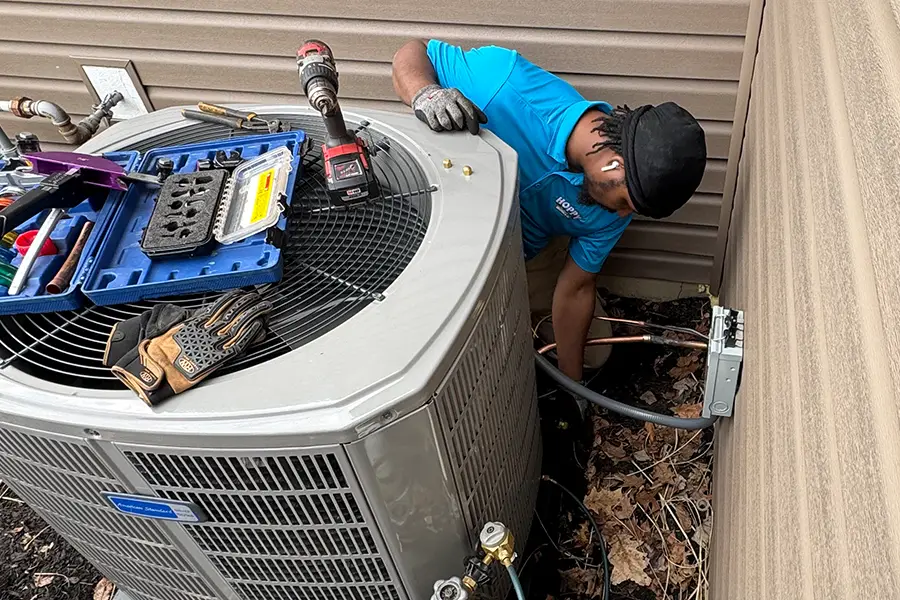
Columbus’s residential landscape ranges from carefully maintained mid-century modern homes in established neighborhoods to newer construction on the city’s northern and eastern growth corridors. The older architectural stock often presents genuine ductwork puzzles, where airflow was designed for an era before modern cooling loads existed. Our technicians approach these situations as diagnostic problems that require real thought, not a rote parts-swap procedure.
- Capacitor and contactor replacement
- Refrigerant leak detection and system recharge
- Blower and fan motor repair and replacement
- Evaporator coil cleaning, repair, and service
- Condensate drain line clearing and pan inspection
- Thermostat troubleshooting and replacement
- Ductwork airflow measurement and diagnosis
We fix what’s broken and tell you what else to watch for. That’s the whole job.
Clues That Your AC System Needs Professional Repair
Columbus sits in the Driftwood River watershed, and summer mornings here often come with enough humidity to remind you that the valley holds moisture differently than higher ground. A system that was performing marginally through a cooler stretch in June will typically reveal itself fully during the first genuine heat wave in July. These are the patterns worth acting on before that moment arrives.
- Indoor humidity feels elevated even with the AC running, producing a clammy sensation
- The farthest rooms from the air handler are noticeably warmer than rooms near the unit
- The system has been running noticeably longer per cycle than it did a month ago
- Frost or ice has appeared anywhere on the indoor or outdoor components
- The outdoor unit makes a sound it didn’t make last season
- Condensation is pooling near the base of the air handler or on the utility room floor
In Bartholomew County’s summer climate, the window between early symptom and full failure can be short. Acting when you notice the first sign almost always produces a simpler and less expensive repair.
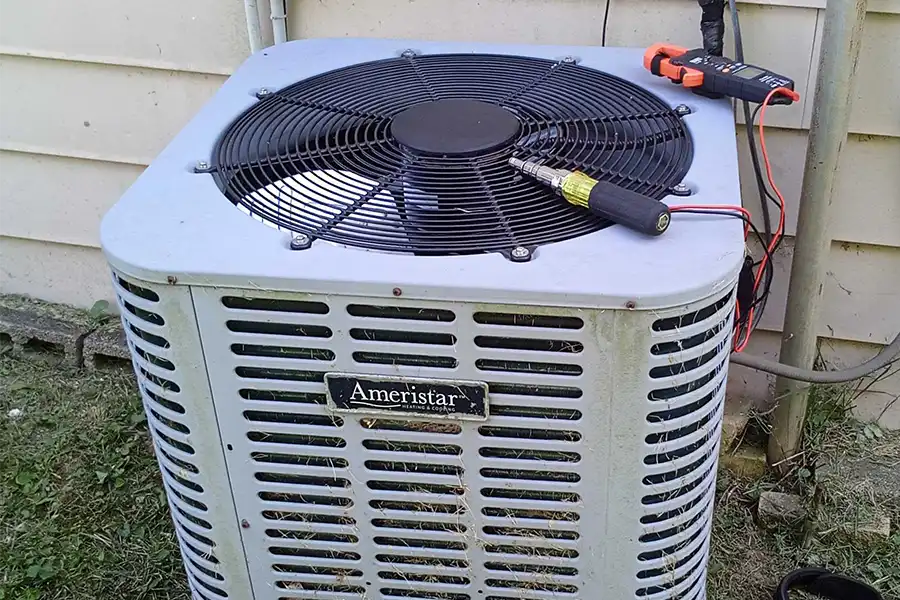
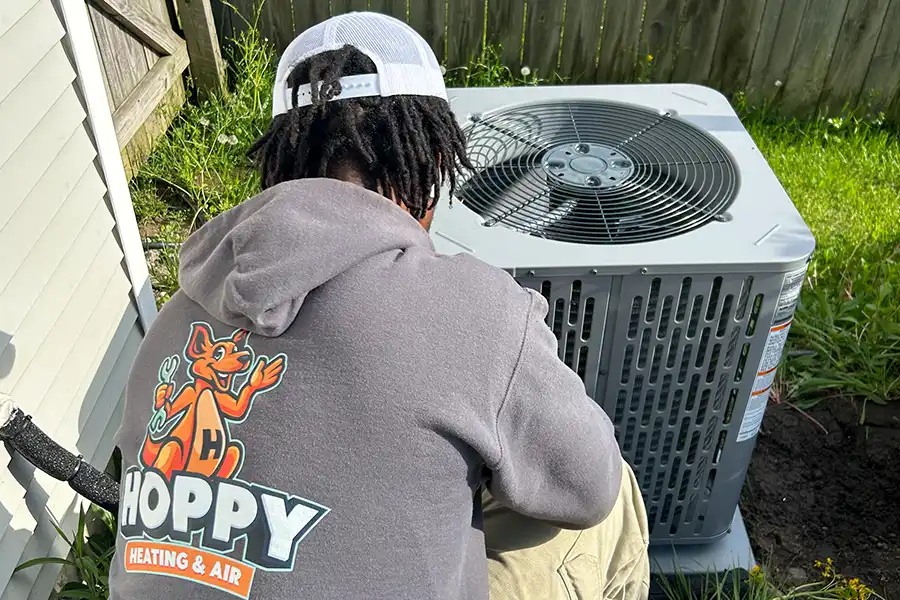
Root Causes of Air Conditioning Problems
Columbus homeowners in established neighborhoods often live in homes where the original ductwork was installed before central air conditioning was a standard feature. When AC was later added, the duct runs were threaded through spaces not designed for them, creating restrictions and leaks that persist decades later. These distribution-side issues compound any equipment-level problems and make thorough diagnosis essential.
- Ductwork leaks in older homes where retrofitted supply and return runs have separated over time
- Low refrigerant from vibration-induced micro-leaks that develop slowly over many cooling seasons
- Condensate drain clogs in a high-humidity watershed environment that promotes biological growth
- Capacitor failure under sustained summer load in systems that have crossed their ten-year mark
- Compressor stress from systems dealing with both equipment wear and ductwork inefficiency simultaneously
In Columbus, a thorough service call frequently uncovers both an equipment issue and a distribution issue contributing to the same symptom. Addressing only one means the problem returns.
What a Furnace Repair Call Looks Like With Our Team
We approach every Columbus furnace call as an opportunity to understand the full system before drawing any conclusions. That means the diagnostic begins before we open the furnace cabinet. We observe the system operating through a complete cycle, note the combustion air pathways, inspect the venting, and check for any environmental factors, unusual odors, pilot behavior, or pressure characteristics, that might inform the diagnostic before we get into the equipment itself.
Inside the unit, we check the heat exchanger, the burner assembly, the ignition system, the flame sensor, the inducer motor and pressure switches, the blower motor and wheel, and all limit and safety controls. For systems venting through masonry chimneys, we also evaluate draft conditions, which can vary significantly based on chimney height, flue liner condition, and outdoor temperature.
Our findings are presented in straightforward language with written upfront pricing for each repair option. We don’t begin work without your approval, and we don’t revise the estimate upward once work has started without an explicit conversation and your agreement. If we find a safety concern, we tell you directly. If the system is in sound condition and needs a targeted repair, we say that too.
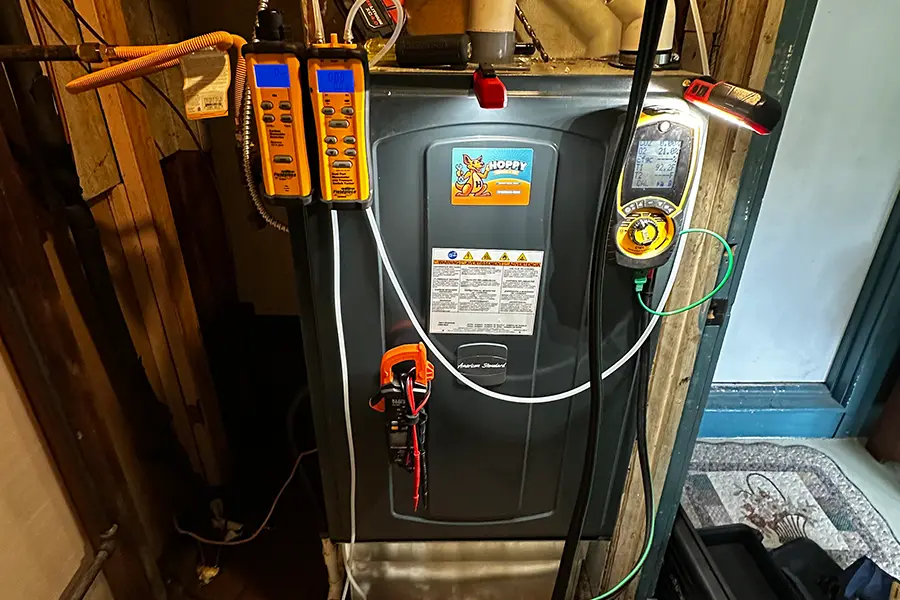

How to Know When Your Furnace Needs a Technician
Columbus homeowners in the city’s mid-century architectural neighborhoods often have homes with original or early-replacement ductwork that wasn’t designed for modern heating loads. In those homes, the signs of furnace trouble can be subtler than in a straightforward suburban build, because the ductwork distribution itself can mask what the furnace is actually producing. These signs, however, are consistent indicators that something needs professional attention regardless of the home’s age or configuration.
- The furnace produces warm air initially but the registers feel cooler as the cycle progresses
- You notice a sulfur or rotten egg smell near the furnace or a gas line, which requires immediate action
- The system starts normally but the blower doesn’t engage after the burner has warmed the heat exchanger
- Condensation or moisture is visible on windows or walls in rooms served by the furnace, paired with poor heating performance
- The furnace runs but the rooms farthest from the air handler stay consistently 5 or more degrees colder than rooms nearby
- You’ve replaced the filter recently and airflow still feels weak at the registers
A sulfur or rotten egg smell near any gas appliance is an emergency, not a warning sign to monitor. Leave the home immediately without operating any electrical switches, and call your gas utility and emergency services from outside. Do not return until the home has been cleared.
A Service Call Near the Downtown Arts District
We received a call in January from Sandra, who owns a mid-century modern home near Columbus’s downtown arts district. The house was architect-designed in the 1960s and the furnace had been replaced once in the 1990s but not since. She said the system had been running constantly for three days without keeping the house above 64 degrees.
Our technician found the furnace was operating but combustion quality was poor. The home had been extensively weatherized several years earlier, and the process had sealed off the crawlspace vents that had previously provided combustion air to the furnace room. The system was drawing combustion air from whatever pathways remained, which wasn’t enough for complete combustion at full fire. The result was reduced heat output, elevated carbon monoxide in the flue gases, and continuous operation as the system tried to compensate.
A dedicated combustion air duct was installed from the exterior to the furnace room, restoring proper combustion air supply. The system was tested under full operation with combustion analysis confirming correct air-to-fuel ratios before the technician left. Sandra’s house reached 70 degrees within two hours of the repair. She mentioned that the weatherization contractor had never discussed combustion air requirements with her when the project was done.
Frequently Asked Questions
What HVAC systems do you service in Columbus, IN?
Hoppy Heating & AC Repair services a wide range of heating and cooling systems, including furnaces, air conditioners, heat pumps, ductless mini-splits, and indoor air quality equipment. Our technicians work on most major makes and models.
How can I tell if my HVAC system needs professional attention?
If you notice uneven temperatures, weak airflow, unusual noises, higher energy bills, strange odors, or frequent cycling, it may be time to have your system inspected. Addressing problems early can help prevent more costly repairs later.
Do you offer same-day HVAC service in Columbus, IN?
We strive to provide prompt service whenever possible. Depending on technician availability and the nature of the problem, same-day service may be available for many heating and cooling issues.
What are the benefits of regular HVAC maintenance?
Routine maintenance helps improve energy efficiency, reduce wear and tear, extend equipment lifespan, improve indoor comfort, and lower the risk of unexpected breakdowns during extreme weather.
Do you provide free service calls?
Yes. Our free service call means there is no charge for us to come out and evaluate your HVAC issue. You only pay if you choose to move forward with the recommended repair or service.
Can HVAC maintenance help lower my utility bills?
Regular maintenance can help your heating and cooling systems operate more efficiently, which may reduce energy consumption and help keep utility costs under control throughout the year.
What areas do you serve?
We proudly serve Columbus, Bartholomew County, and surrounding communities. Contact Hoppy Heating & AC Repair to see if we provide service in your neighborhood.